


MorganRecruiter
Proceed
Relevant delivery experience. Explore Alex’s own decisions in the next conversation.

Role-specific candidate evaluation
TrueRole brings résumés and CVs, work samples, screening responses, interviews, and team feedback into one evolving, evidence-backed evaluation. See what each candidate has demonstrated, what remains unclear, and what to validate next.
Use TrueRole on its own or alongside your ATS.
Role fit
Great fit
Principal Product Designer
Portfolio case studies support complex product design.
EvidenceRelevant work across complex workflows.
Explore nextValidate ownership of outcomes.
Career trajectory
Aligned10.2 years of role-relevant experience
Application checks
No issues flagged in completed checks.
Define the capabilities, responsibilities, and level of experience that matter, shaped by the role and organizational context.
Evaluate relevant experience, portfolios, and supporting work against the same criteria.
Use focused screening and interviews to build on what the available evidence already shows.
Review the findings alongside each team member’s observations and recommendations.
Start with each candidate’s overall role fit, then explore requirement-level findings, career context, and supporting sources. See where experience aligns—and what still needs a closer look.
Role fit Requirement evidence Supporting materials
Combine your job description with TrueRole’s role and level frameworks, plus organization and industry context. Review the resulting requirements, weights, and evidence guidance.
Four inputs. One tailored set of criteria.
Responsibilities, priorities, and expected outcomes
The capabilities this type of role calls for
Scope, autonomy, and seniority expectations
The environment in which the work happens
TrueRole combines these inputs into weighted requirements and evidence guidance. Review the criteria, then apply the same lens to every candidate.
Sr. Principal Product Designer
Ordered by weight · Evidence guidance shown for the first requirement
Independently leads complex initiatives end to end, sets strategic design direction, and drives outcomes across a critical domain.
Level expectation
Owns major product areas from concept through implementation, with responsibility for strategy, quality, and outcomes across teams.
Drives complex work from discovery through implementation, balancing user needs, business goals, and technical constraints.
Showing 2 of 15 requirements
Turn gaps in the evaluation into focused screening and interview questions. As candidates share more, keep the new information connected to the same role requirements.
Prepare questions informed by each candidate’s experience and what’s still unclear. Candidates can respond by video, voice, or text, on their own schedule.
Explore Screening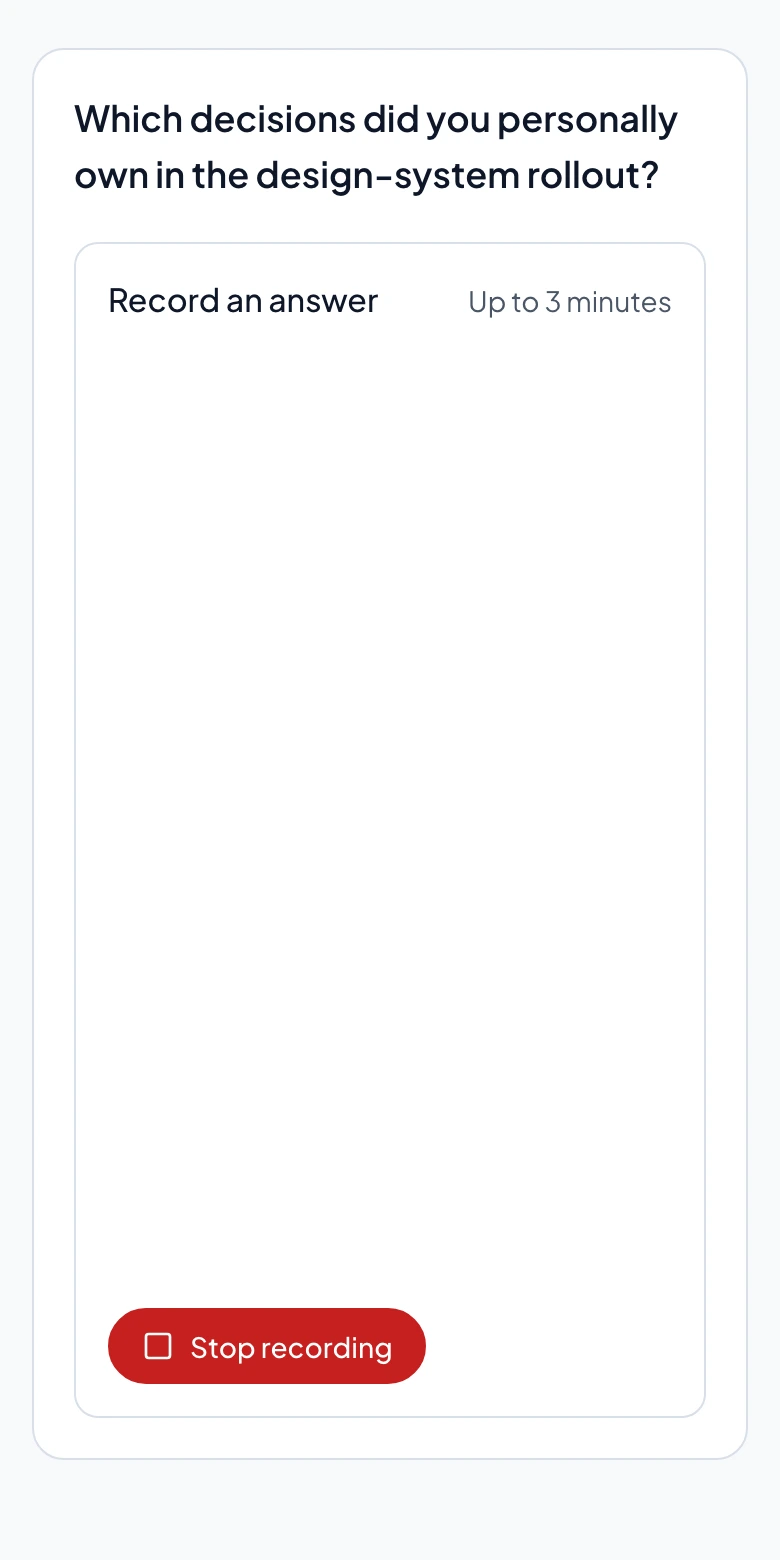
Prepare questions that build on existing evidence, with guidance on why to ask, what to listen for, and where to explore further.
Explore Interview IntelligenceAlex · Principal Product Designer
Hiring manager interview
Which strategic decisions did you personally own, and how did you measure their impact?
The portfolio describes the rollout, but does not establish Alex’s strategic ownership or its impact.
Specific decisions Alex owned, the tradeoffs involved, and evidence of what changed after the rollout.
Guidance connects the role requirements to what still needs validation.
Recruiters, hiring managers, and interviewers bring different perspectives. TrueRole keeps their observations and recommendations connected to the same role requirements and supporting evidence, so teams can see where views align and what needs discussion.

Alex · Principal Product Designer
Same role. Same evidence. Each reviewer’s judgment.
MorganRecruiter
Relevant delivery experience. Explore Alex’s own decisions in the next conversation.
JordanHiring manager
I’d like to understand strategic ownership and see the adoption outcomes before proceeding.
Create roles and evaluate candidates directly in TrueRole, or use it to deepen evaluations alongside your existing recruiting workflow.
ATS integration availability varies by workspace. Ask about your ATS.
Human judgment, supported
TrueRole helps surface relevant evidence and make uncertainty visible. Your team reviews the findings and decides what happens next. Recognized personal details are masked in text prepared for AI scoring, while workspace permissions help control access to candidate information.
See how role-specific requirements and candidate evidence come together to support your next hiring decision.